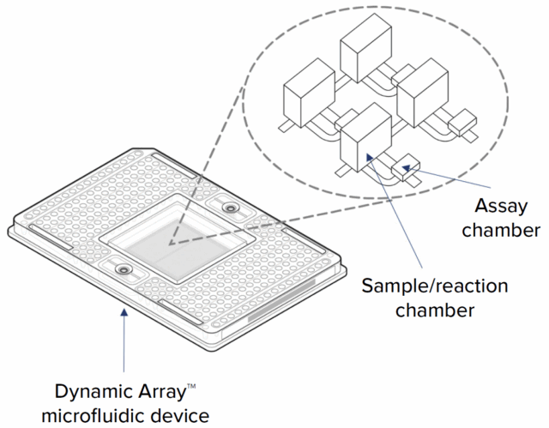
Proven proprietary technology: How it works
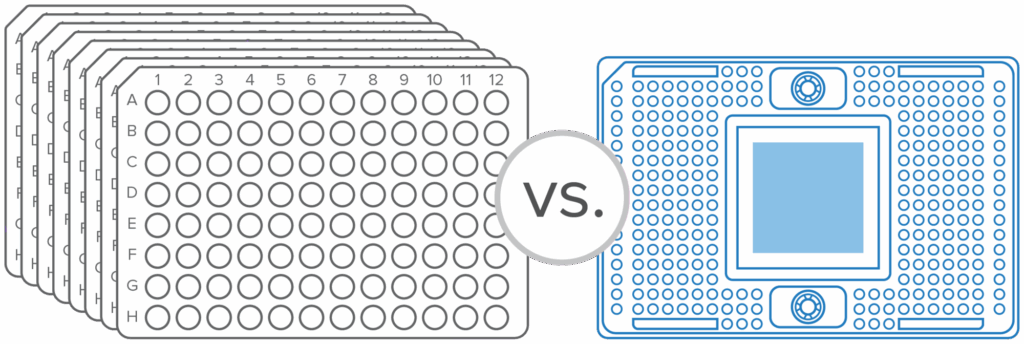
Experiments are easily transferable to IFCs and require a fraction of the sample and reagents needed for microplates. IFCs are precisely fabricated in microscopic dimensions with extremely accurate volumetric chambers for nanoscale processing of individual reactions.
Key benefits of IFCs
Scalable
Multiple IFC formats make it easy to manage dynamic sample or assay counts.
Flexible
Open architecture allows the user to easily add, remove, replicate or change assays within a panel.
Cost-effective
Reduce cost and waste through lower consumption of reagents and lab plastics.
| Applications | Samples/Targets | Partitions | Datapoints | ||
|---|---|---|---|---|---|
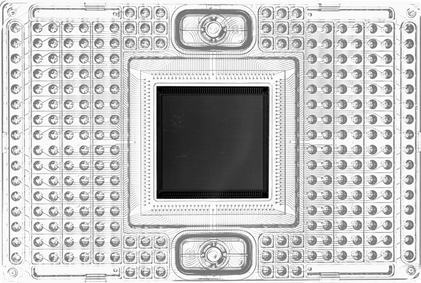
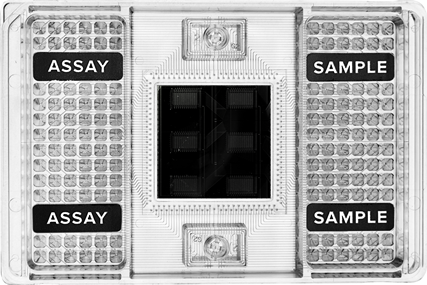 | Flex Six™ IFC Lowest sample throughput via six partitions that each support a matrix of 12 samples by 12 assays. Each partition can be run separately or together to support target selection and protocol development | GE, qPCR, GT | 12/12 | Six | 864 |
| 24.192 IFC Low sample throughput with high-content capacity, which allows labs to add assays as needed | GE, qPCR, GT | 24/192 | One | 4,608 |
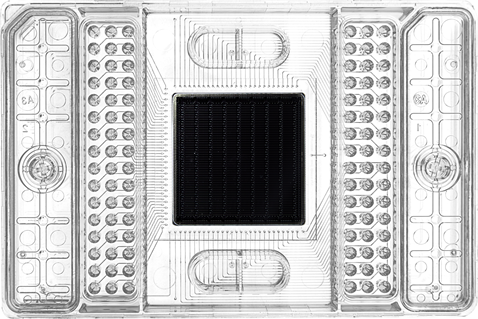 | 48.48 IFC Mid-capacity to support early-phase discovery and low-volume testing sessions | GE, qPCR, GT | 48/48 | One | 2,304 |
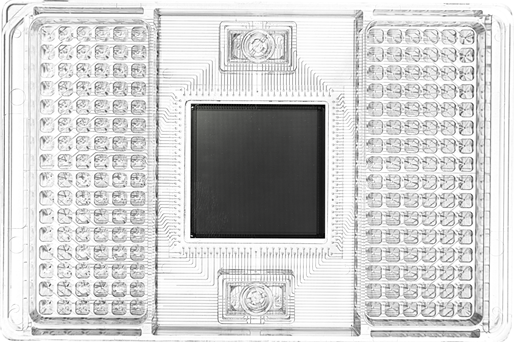 | 96.96 IFC and 96.96 GT Preamp IFC-X Superior data-generation capacity for deep sample profiling with option for integrated preamplification | GE, qPCR, GT | 96/96 | One | 9,216 |
| 192.24 IFC High sample throughput to support peak seasonal and large studies | GE, qPCR, GT | 192/24 | One | 4,608 |
| Number of samples per run | Number of assay targets per sample | Amplicon length | Turnaround time from DNA to NGS-ready libraries (one IFC run) | Sample throughput in 24 hours | Number of samples multiplexed per NGS run | |
|---|---|---|---|---|---|---|
| LP 8.8.6 IFC Up to 48 | >1,600 per partition >9,600 per IFC | 150-500 base pairs | About 9 hours (includes 4.5 hours walk-away automation) | Up to 96 sample libraries | Up to 1,536 using Biomark Scientific barcodes |
| LP 48.48 IFC Up to 48 | Up to 4,800 | 150-500 base pairs | 8 hours total (includes 4 hours walk-away automation) | Up to 96 sample libraries | Up to 1,536 using Biomark Scientific barcodes |
| LP 192.24 IFC Up to 192 | Up to 2,400 | 150-500 base pairs | 9.5 hours total (includes 5.5 hours walk-away automation) | Up to 384 sample libraries | Up to 1,536 using Biomark Scientific barcodes |
For more information on specific IFCs, kits and product numbers, visit the catalog or complete this form and a technical specialist will connect with you.
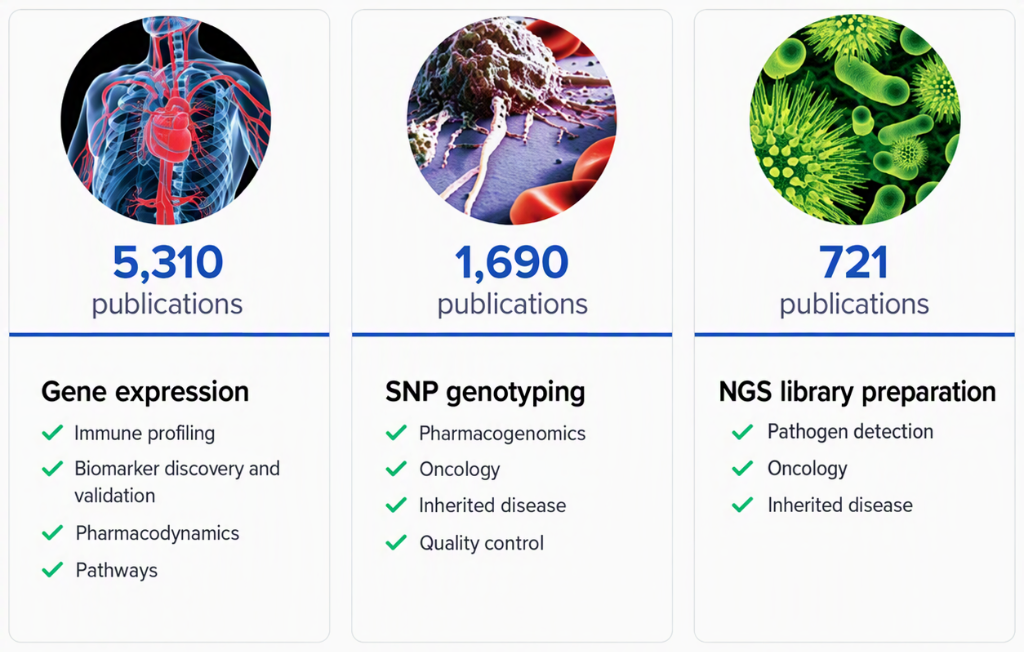
More than 9,000 publications referencing IFCs in genomics